
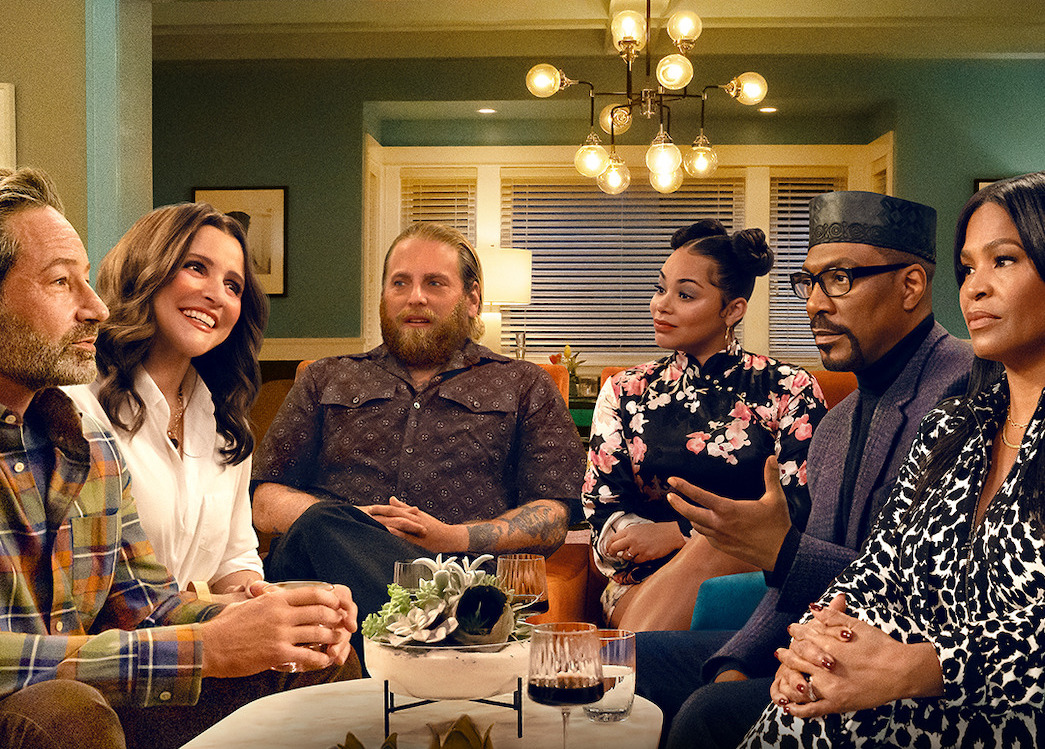
This is Why ‘You People’ is a Cringy Mess
By Aaron Gold

How bad is it? Is the latest Jonah Hill movie ‘You People’ harmful to Jews? The answers are yes and yes, but let me explain why. The top ten Netflix movie begins by trying to set itself apart from other controversial Jewish content with an attempted reformation of the classic Roth adaptation of Portnoy’s Complaint.
Published in 1969, Portnoy’s Complaint is arguably one of the most famous Jewish novels of the post-WWII era. It follows a guilt-induced, self-hating, sex-obsessed and ultimately violent Jewish man named Alexander Portnoy who rants to his therapist about his escapades and misadventures. Roth later called it a youthful indiscretion.
But at the time it broke records, made Roth even more famous than he already was and caused an outcry in some parts of the Jewish community. Roth was accused of legitimizing the worst anti-Jewish stereotypes, a charge he always denied and brilliantly explored in his later novels.
Most of all, it is a major lost opportunity to have real conversations about not just inter-relationships and marriages, but relations between our two communities.
The criticism of Roth. The criticism comes during Yom Kippur when after the service, multiple elders pester Ezra, Jonah Hill’s character, about his love life. “It’s 2022. Maybe the kid enjoys smoking the Hebrew Nationals” one man says. “I know you’re trying to be progressive, but it’s coming off crazy homophobic,” Ezra retorts. That’s when Dr. Green, played by Richard Benjamin, the famous actor in Goodbye, Columbus and Portnoy’s Complaint, shows up.
“Hey, hey, bud, bud”
“Hey, Doc”
“Hi, how’s your penis?”
“Uh, I think it’s…I think it’s good”
“Yeah, uh, listen, uh, come with me. Let’s go to the bathroom and, uh, we’ll take a look, okay?”
“I’m good”
“No, no, it’s fine. It’s fine”
To the layman, it’s an incredibly odd and outwardly perverted scene. To those of us who understand the reference, it’s funny, especially seeing Benjamin, 84, who rarely works anymore. His last credit was in 2015. The framing is obvious a minute later.
Ezra’s mom, Shelley, played by Julie Louis-Dreyfus, promptly tells her son that his childhood orthodontist is in a lot of legal trouble, but hasn’t yet been convicted. The message is pretty clear. This isn’t going to be your parent’s iconoclastic screed, but a new guilt-induced, histrionic, self-hating culturally conscious, Guess Who’s Coming to Dinner one. In short, if we are going to make a movie about the flaws and failures in the Jewish community, unlike previous work (an inaccurate and horrible take) we are going to have a progressive message.
However, it fails even in that task.

It never deals with its core antisemitic theme. The strange thing about You People is that it is supposed to be a movie that opens up conversations, but it spends the entire time avoiding them. It never really explores the core issues that might arise in a Black and Jewish or a Muslim and Jewish relationship, such as one’s core values, relations between husband and wife or how to raise one’s kids. There is a brief argument about who should officiate at the wedding, but that is about it.
Most of all, it is a major lost opportunity to have real conversations about not just inter-relationships and marriages, but relations between our two communities.
The movie pits Ezra and his family, a well-meaning, but patronizing and tone deaf liberal family against his fiance Amira, played by Lauren London (whose father in real life is Jewish) and her family, a conservative, antisemitic group of followers of the Nation of Islam. It is, of course, supposed to be a modern play on the 1967 ground-breaking classic Guess Who’s Coming to Dinner and perhaps the more recent 2005 movie Guess Who.
Trope after trope. You People never really goes downhill because it’s pretty bad from start to finish. It brings up almost every anti-Jewish trope with almost no analysis or push-back. You People pushes the antisemitic tropes that:
Jews are chameleons that can covertly integrate into society
Jews are sexual deviants
Jews are not only responsible for, but were the main financial beneficiaries of slavery
Jews are inherently racist
Jews still profit off of the exploitation and co-optation of Black labor and culture
Jews are rich, white and privileged, the epitome of old money
Jews are drug addicts and privileged societal degenerates
Jews are pushy
Jews only care about themselves
Jews are well-connected, corrupt and powerful
The pushback against these tropes is either non-existent or lazy and stereotypical. During the climax at the widely-discussed dinner scene, Shelley tries to bridge the gap between the two families, by does so poorly. For example, she says that both Jews and Black people have a history of suffering. Eddie Murphy’s character Akbar (formerly Woody), the father, immediately accuses her of comparing the Holocaust with slavery, which she says she wasn’t and wasn’t intending to do.
Discussing Farrakhan, when Akbar asks Shelley if she is familiar with Farrakhan, she bluntly says: “I’m familiar with what he’s said about the Jews”. And in response to Fatima and Akbar’s classic Farrakhn conspiracy theory that Jews profited off of slavery, David Duchovny’s character Arnold, Ezra’s dad, promptly says: “I want to see your sources on that”. The tone is such that when Ezra’s family defends themselves against Akbar and Fatima’s anti-Jewish accusations, they do so in such a clumsy way, Amira’s family falsely perceives their response as justification and proof of their initial prejudicial claims.
There is no nuance, not real analysis of the differences between Black, Muslim, and Jewish families. There is no desire to understand, no desire to educate, no desire to empathize; there are just lazy and ignorant stereotypes.
In short, Ezra’s white-passing, upper-class presumably Ashkenazi family who are just assumed to be representative of world Jewry, are clumsy and clueless, but they mean well. There is no mention that a significant percentage of Jews are People of Color. Amira’a parents, on the other hand, are blatantly and proudly antisemitic. That is the uncomfortable, but obvious difference.
Hate group. Perhaps most importantly, from the Jewish perspective, Kenya Barris and Jonah Hill, the writers and director, never deal with the elephant in the room. That elephant, of course, is that the Nation of Islam is a recognized hate group. That is a fact, one that cannot be rationalized or dismissed or explained away. Ezra’s family might have some serious unconscious biases to work through, but they are not in the business of following someone who advocates genocide. Louis Farrakhan, the leader of the Nation of Islam, is one of America’s most well-known and unapologetic antisemites. His rhetoric is Hitlerian, calling Jews rats, Satanic, fake, accusing Jews of blood libels and calling for violence against the Jewish people.
The core conflict. The core conflict in You People is that both sets of parents see their child’s fiance in the abstract. At the heart of the movie is a false equivalency between both families. On one hand, Ezra’s parents are patronizing in their unctuousness. Despite having good intentions, their welcoming comes off as seeing Amira not as a real person, but as a prop, a classic racist trope; yet, they are supportive of the marriage.
When Ezra tells his mom that he is going to propose, his mom is not only accepting but thrilled. “Oh, Ezra, you’re my baby boy. And you found an amazing woman who makes you happy. End of story,” Shelley tells him.
On the other hand, Amira’s family has deep-rooted prejudice against Jews. Akbar, for instance, begins with his antisemitism when first meeting Ezra. “So do you hang out in the hood all the time, or do you just come up here for our food and women,” Akbar says. “It’s a valid question,” his wife, played by Nia Long, says.
In an attempt to placate his future in-laws, Ezra continuosly plays dumb. For him, it’s not important that his fiance belongs to a hate group that calls for violence against his people. Ezra doesn’t even seem to care that her dad admires a man whose language has inspired multiple terrorist attacks against Jews.
Ezra’s strategy of downplaying and looking the other way when confronted with antisemitism is a common one throughout Jewish history; one that is often analyzed in Jewish texts, literature and memory. However, I don’t think You People is supposed to be a serious analysis of Jewish responses to antisemitism. But, despite its intention, Jews know from experience that while comedy and satire are key components in a civilization’s arsenal against hate, sticking one’s head in the sand is a tried and true failed strategy.
The moral of the story. In the end, the moral of the movie is that to make an intermarriage work, one must deny his or her own identity to placate the biases and prejudices of their mate and pitfalls in their relationship. We are told that Ezra and Amira’s relationship works because their attachment to their Jewish and Nation of Islam identity is an afterthought.
Ezra’s Jewish identity is universalized into a standard refrain of “you don’t see me as an individual”. Amira’s family is never forced to confront their specific anti-Jewish hatreds.
This was a hard review to write because I have so much love for the core cast. But, unfortunately, it was not a good movie. It gives air, instead of fire, to many classic antisemitic tropes without sufficient analysis or pushback. The premise is fundamentally flawed in how it equates both families. It completely white washes Jews of Color. And most of all, it is a major lost opportunity to spark a real dialogue between our communities.
By Aaron Gold. Aaron Gold is a writer and the founder of The Hasmonean.
Stay up-to-date on the latest movies and find out what’s worth watching on The Hasmonean. Get the latest movie reviews, news, trailers and much more.
